

EPC Group Launches Multi‑AI Power BI Architecture Connecting Five AI Engines to Enterprise Analytics
Power BI + AI Done Right: The $50 Million Integration Opportunity
Virtual Chief AI Officer (vCAIO) service - The First In the Industry - EPC Group's AI Consulting Services
EPC Group Power BI Consulting and Microsoft Fabric Consulting Practice Experts Top G2 Rated in North America
New multi‑AI Power BI architecture from EPC Group connects five AI engines to enterprise data, enabling governed natural language AI queries.
The architecture was developed in response to a consistent pattern across EPC Group’s enterprise clients: leaders want to use AI and natural language queries to interrogate reports, pipelines, and KPIs, but IT teams cannot afford to create parallel AI “shadow systems” that bypass Power BI governance, tenant‑level security, or existing Microsoft investments.
The new multi‑AI design integrates five AI models behind a governed Power BI semantic layer. It enables users to ask questions in natural language, get narrative explanations, and explore scenarios while all metrics, dimensions, and row‑level security remain centralized in Power BI and Microsoft Fabric. Rather than pushing users directly into unmanaged AI tools, the architecture treats AI as an interface and reasoning layer on top of curated enterprise data and Microsoft 365 workloads.
“Enterprises do not need another data silo or another AI tool that hallucinates whatever it wants,” said Errin O’Connor, Founder and Chief AI Architect at EPC Group. “They need AI to sit on top of governed semantic models, honor security, and help executives understand what is happening in the business without rewriting their entire analytics stack. That is exactly what this multi‑AI Power BI architecture is built to do.”
The architecture is the product of EPC Group’s work on more than 1,500 Power BI deployments, 500 Microsoft Fabric implementations, 5,200 SharePoint projects, and 700 AI solutions tested across industries including financial services, healthcare, manufacturing, logistics, and commercial real estate. Many of those organizations are now asking the same set of questions: how do we add AI to analytics without breaking governance, and how do we connect AI to the rest of our Microsoft 365 estate instead of standing up point solutions.
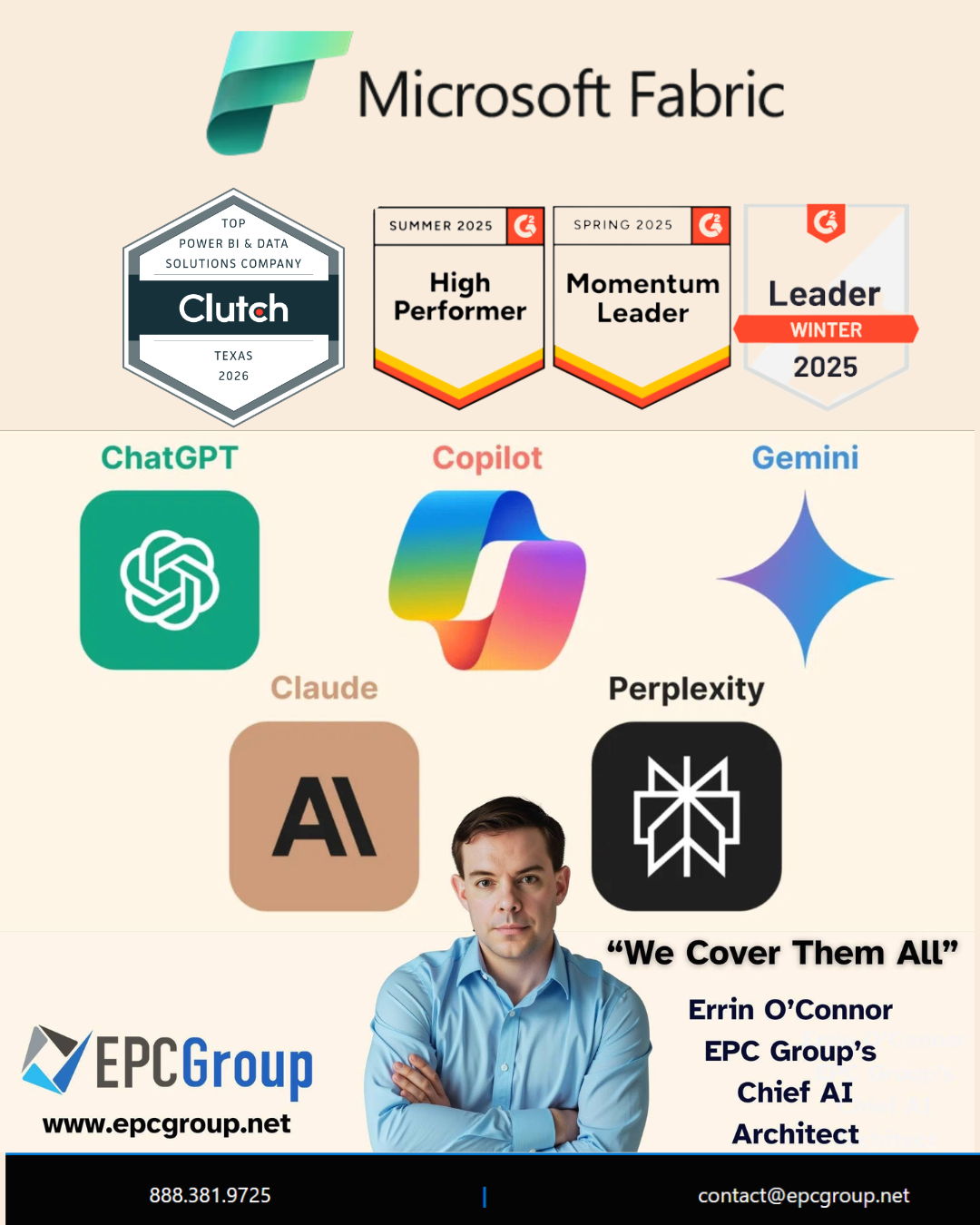
EPC Group’s multi‑AI design keeps Power BI and Microsoft Fabric at the center of the analytics estate while orchestrating multiple AI engines—such as Microsoft Copilot, Claude, Azure OpenAI, Perplexity, and other leading models—through a common pattern. Power BI semantic models and OneLake act as the source of truth. AI is used for question understanding, narrative generation, summarization of complex reports, and multi‑step reasoning across workspaces, apps, and workstreams. This approach allows organizations to use the best model for each class of task while keeping governance anchored in the Microsoft stack.
Crucially, the architecture extends beyond pure reporting. EPC Group is connecting the same multi‑AI layer to SharePoint document libraries, Power Apps line‑of‑business applications, and Power Automate workflows so that insights can drive actual action. An executive might ask a natural language question in a governed Power BI experience, receive an AI‑generated explanation of the variance, and then trigger a Power Automate flow or update data through a Power App, all within the same governed environment.
For organizations undergoing tenant‑to‑tenant migrations or consolidating multiple Microsoft 365 environments, the firm is also embedding AI into the migration process itself. AI‑assisted assessments can help identify unused workspaces, redundant reports, misconfigured permissions, and risky sharing patterns before consolidation. During tenant‑to‑tenant and cross‑cloud migrations, EPC Group’s teams use the same architecture to validate that migrated Power BI, SharePoint, Teams, Power Apps, and Fabric workloads behave as expected and that governance policies remain intact.
“This is not just about making dashboards talk,” O’Connor said. “It is about using multiple AI engines to understand lineage from source systems through Fabric pipelines, Power BI semantic models, SharePoint content, and Power Apps, and then helping clients automate the right next step with Power Automate. When you add tenant‑to‑tenant and AI‑powered migrations into that picture, you get an end‑to‑end view of both data and risk.”
The multi‑AI Power BI architecture fits into EPC Group’s broader work on semantic model governance, report‑sprawl reduction, and refresh reliability. As organizations adopt Fabric, Direct Lake models, and more complex data estates, they want AI‑driven experiences that sit on top of the same trusted models rather than duplicating logic in separate tools. The firm’s methodology typically begins with discovery and use‑case definition, followed by Fabric and Power BI architecture review, data governance assessment, and security mapping across Microsoft 365, SharePoint, Power Apps, and Power Automate.
Engagements then move into AI model selection, prompt and orchestration design, and deployment of initial AI‑assisted reporting and decision‑support experiences for priority business stakeholders such as finance, operations, sales, and IT leadership. EPC Group emphasizes enablement and knowledge transfer, training internal teams to operate, extend, and govern the multi‑AI environment instead of creating permanent dependence on outside consultants.
The company’s Microsoft ecosystem work spans Microsoft 365, SharePoint, Teams, Azure, Microsoft Copilot, Intune and endpoint management, enterprise data governance, and AI risk management. That gives EPC Group a unique perspective on how AI‑enabled analytics interacts with identity, permissions, device posture, regulatory requirements, and unsanctioned “bring‑your‑own‑AI” behavior.
Founded in 1997, EPC Group is one of North America’s longest‑standing Microsoft partners and has been recognized as a G2 Leader in Business Intelligence and Microsoft consulting with a Net Promoter Score of 100. The firm has delivered more than 11,000 engagements over 29 years for organizations including NASA, the FBI, the Federal Reserve, the Pentagon, United Airlines, PepsiCo, Nike, Northrop Grumman, and more than 70 Fortune 500 companies.
Organizations interested in adding multi‑AI capabilities to their Power BI, Microsoft Fabric, SharePoint, Power Apps, Power Automate, and tenant‑to‑tenant migration programs can learn more at EPC Group’s Power BI consulting and AI consulting services pages at www.epcgroup.net or by emailing EPC Group at contact@epcgroup.net.
Michelle Stevens
EPC Group
+1 888-381-9725
email us here
Visit us on social media:
LinkedIn
Bluesky
Instagram
Facebook
YouTube
TikTok
X
Other
Multi-Layer AI on Power BI | CoPilot + Claude + OpenAI + More | Power BI + Fabric + Multi AI Options
Legal Disclaimer:
EIN Presswire provides this news content "as is" without warranty of any kind. We do not accept any responsibility or liability for the accuracy, content, images, videos, licenses, completeness, legality, or reliability of the information contained in this article. If you have any complaints or copyright issues related to this article, kindly contact the author above.
